As a project manager in the industrial sector, you operate at the intersection of three critical pressures: schedule, budget, and risk.Every decision is weighed against its impact on these factors. The traditional method of “stick-building” complex process systems on-site has long been the default, but it leaves projects highly exposed to variables that can derail even the best-laid plans, weather delays, unpredictable field labor costs, and significant on-site safety exposure.
There is a more strategic approach. Modular construction, centered around the fabrication of pre-engineered process skids, is not just an alternative construction method; it’s a comprehensive project execution strategy designed to give you greater control over every critical variable.
This guide provides a clear, end-to-end overview of modular process skid design and fabrication, answering the key comparative questions project managers face and outlining a proven path to a more predictable and successful project outcome.
What Exactly is a Modular Process Skid?
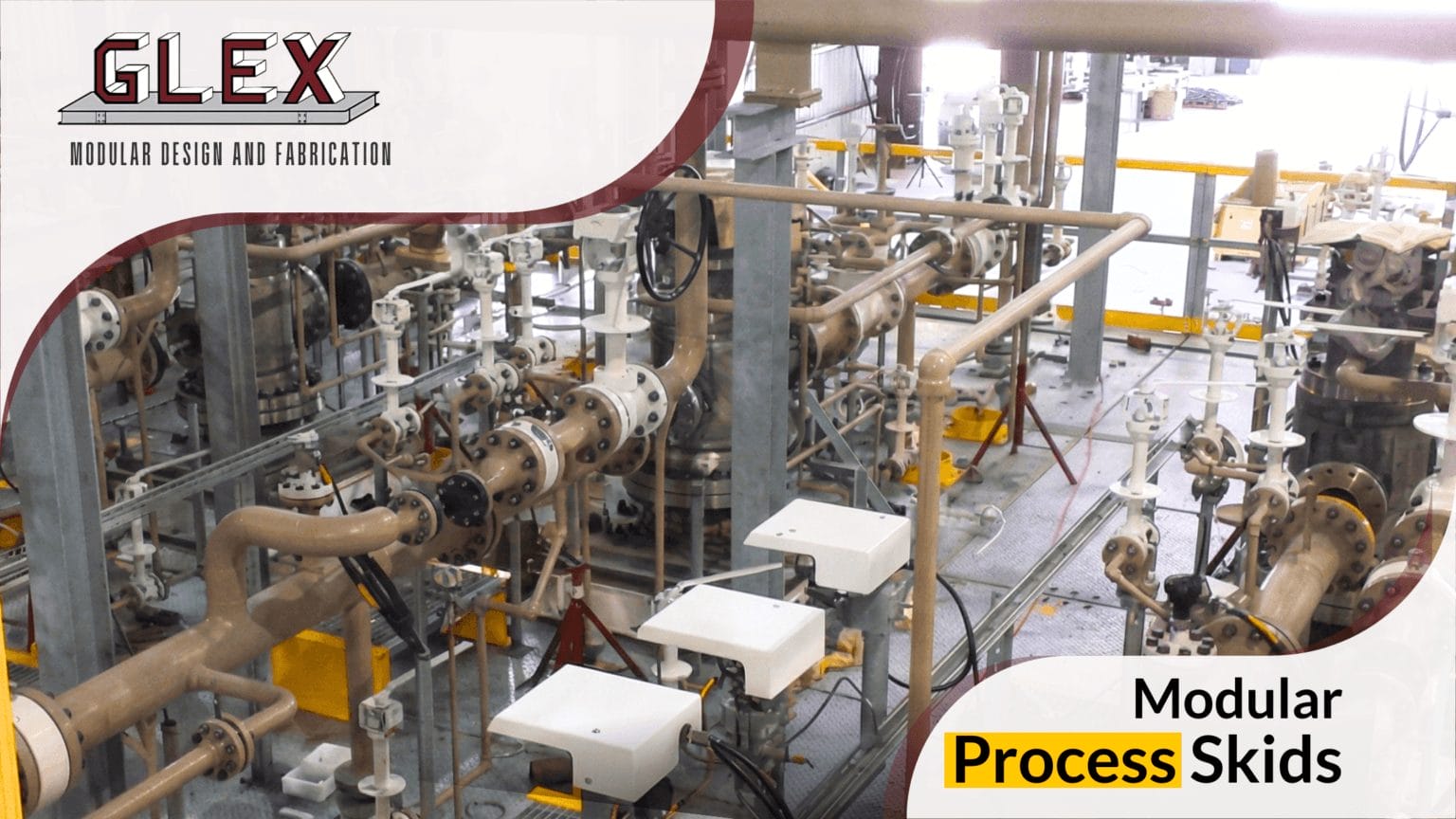
A modular process skid is a self-contained, engineered system built onto a structural steel frame. Think of it as a “plug-and-play” component for your larger plant or facility. Instead of assembling countless individual parts, pumps, vessels, piping, instruments—in the field, the entire system is built, piped, wired, and tested in a controlled fabrication shop.
Once complete, this entire “module” is transported to your site as a single unit, ready to be set on its foundation and connected to your main facility at a few predefined tie-in points.
The Core Comparison: Modular Fabrication vs. Stick-Built
For a PM, the decision to go modular comes down to a direct comparison of tangible project metrics.
| Metric | Stick-Built (On-Site) | Modular Fabrication (Off-Site) | The Project Manager’s Advantage |
| Schedule | Sequential: Site work must finish before mechanical work begins. Vulnerable to weather. | Parallel: Skids are built simultaneously while site/civil work is done. Immune to weather. | Accelerated Timelines (by up to 50%) |
| Cost | High, unpredictable field labor rates. Risk of overtime & per diems. | Controlled, predictable shop labor rates. Higher efficiency. | Increased Budget Certainty |
| Quality | Variable, dependent on field conditions (wind, rain, welder skill). | Superior, consistent weld quality in a controlled environment. | Higher Reliability & Less Rework |
| Safety | High on-site man-hours in a congested, hazardous environment. | Drastically reduced on-site hours. Work is done in a safer, controlled shop. | Significantly Reduced Safety Risk |
| Footprint | Sprawling, requires significant laydown area. | Compact, engineered design with an optimized, smaller footprint. | More Efficient Use of Plot Space |
The Modular Design & Fabrication Process: From P&ID to Delivery
Understanding the modular workflow demystifies the process and highlights the key control points that ensure quality and predictability.
Step 1: Engineering & Design (The Digital Twin)
The process begins with your P&ID and project specifications. Our engineering team translates this into a detailed 3D model. This “digital twin” is critical; it allows us to identify and resolve any potential pipe clashes, accessibility issues, or maintenance challenges before a single piece of steel is cut. This is a level of proactive problem-solving that is impossible in a stick-built environment.
Step 2: Procurement & Material Control
With an approved design, all materials are procured. At Glex, this is a tightly controlled process. Every component, from a pressure vessel to a single bolt, is tracked. Material Test Reports (MTRs) are verified to ensure everything meets or exceeds project specifications.
Step 3: Fabrication & Assembly (Controlled Excellence)
This is where the parallel advantage becomes real. In our Houston fabrication facilities, certified welders and pipefitters work in a controlled environment. Key advantages include:
- Dedicated Shops: We use separate shops for carbon steel and stainless/exotic alloys to prevent cross-contamination.
- Precision Tooling: Jigs and fixtures ensure perfect alignment and dimensional accuracy.
- Consistent Quality: Work is never compromised by wind, rain, or harsh field conditions.
Step 4: Factory Acceptance Testing (FAT)
Before the skid ever leaves our shop, it undergoes a rigorous Factory Acceptance Test (FAT). This can include hydrostatic testing, full functional checks of instrumentation, and continuity testing of all electrical wiring. This crucial step confirms the system works as designed, transforming a potential on-site startup problem into a simple pre-shipment quality check.
Step 5: Logistics & Delivery
Once the FAT is successfully completed by your team, the module is prepared for shipment. As a single unit, it is loaded and transported to your site, ready for a streamlined installation process that can reduce on-site mechanical work from months to mere days.
Glex: Your End-to-End Modular Partner
The success of a modular project hinges on the capabilities of your fabrication partner. At Glex, we combine decades of specialized engineering experience with world-class fabrication facilities to deliver certainty. Our process is designed to integrate seamlessly with your project team, providing the transparency, quality, and predictability you need to meet your goals.
Ready to de-risk your next project? Submit your P&ID and project specifications, and let our experts demonstrate how a modular approach can put you on the path to a faster, safer, and more cost-effective outcome.