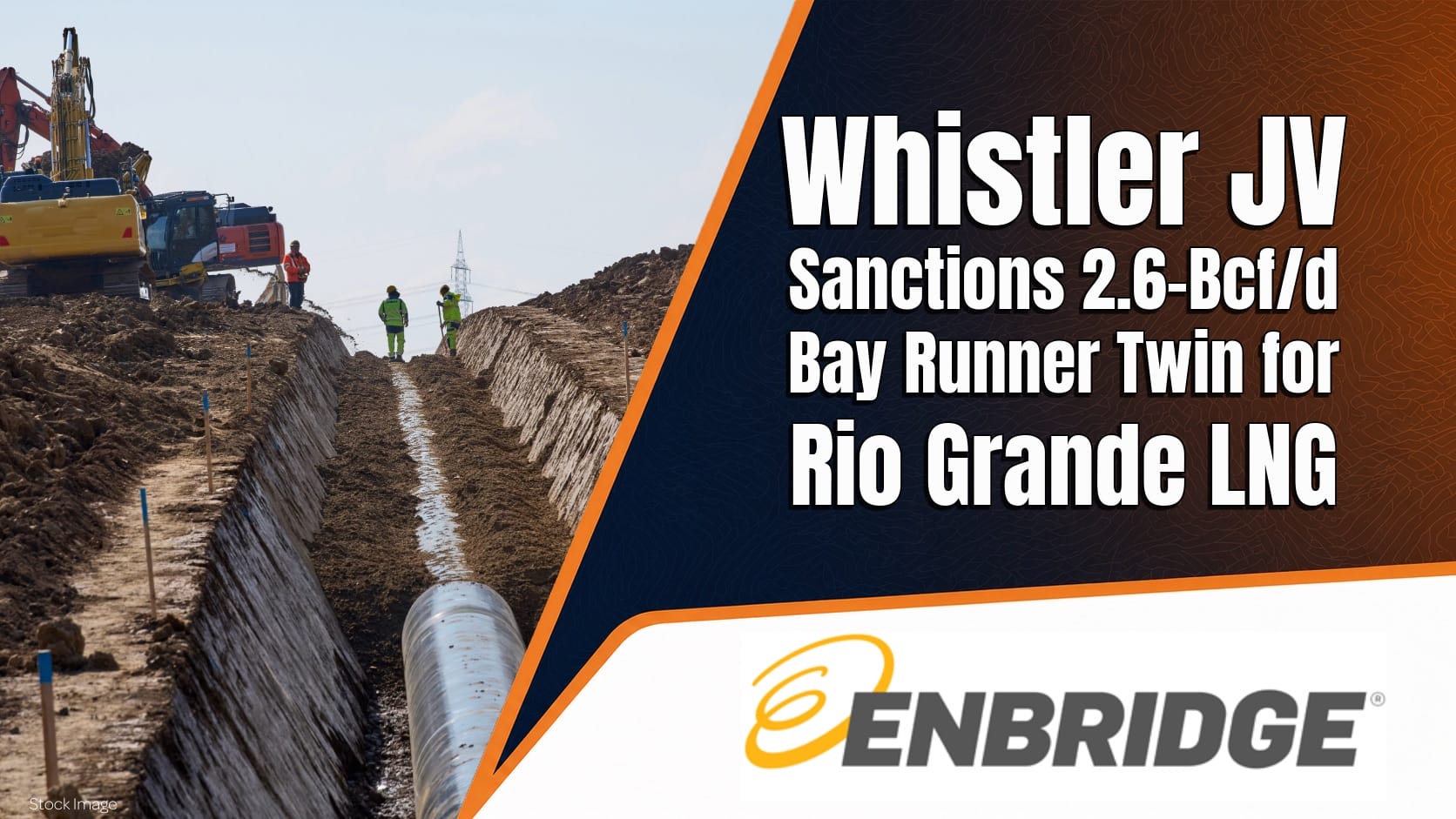
The fully contracted South Texas pipeline will follow the Bay Runner corridor from Agua Dulce toward the Rio Grande LNG complex, with Enbridge currently targeting service by 2030.
Published by Allstream Insiders
Allstream Insiders Summary
Enbridge and its Whistler joint-venture partners have sanctioned the Bay Runner Twin, a natural gas pipeline designed to provide up to 2.6 billion cubic feet per day of incremental capacity between Agua Dulce and NextDecade’s Rio Grande LNG facility in South Texas. Enbridge said the project will follow the right-of-way of the original Bay Runner Pipeline and is supported by long-term take-or-pay agreements covering all of the new capacity.
Enbridge currently expects the Bay Runner Twin to enter service by 2030. The company has not announced the project’s capital cost, exact pipeline length, pipe diameter or construction contractors.
The project is being advanced through the Whistler Parent joint venture, which is owned 50.6% by WhiteWater/I Squared Capital, 30.4% by MPLX and 19% by Enbridge. That ownership structure means Enbridge is a minority partner rather than the sole owner of the pipeline.
The original Bay Runner Pipeline is already under construction. Its project website describes an approximately 145-mile intrastate system designed to move up to 2.64 Bcf/d from the Agua Dulce supply area to a terminus near Port Isabel. NextDecade reported in July that Bay Runner remained on track to enter service during the third quarter of 2026.
MPLX reports that Bay Runner and Bay Runner Twin together will provide up to 5.3 Bcf/d of transportation capacity between Agua Dulce and the Brownsville area. The twin is intended to support additional liquefaction trains at Rio Grande LNG as that development expands beyond its first phase.
Bay Runner and Permian-to-LNG Project Tracker
| Project | Confirmed scope | Capacity | Reported status and schedule |
|---|---|---|---|
| Bay Runner Twin | New pipeline following the existing Bay Runner right-of-way between Agua Dulce and Rio Grande LNG | Up to 2.6 Bcf/d of incremental capacity | Sanctioned and fully contracted under long-term take-or-pay agreements; Enbridge expects service by 2030 |
| Bay Runner Pipeline | Approximately 145-mile intrastate pipeline from the Agua Dulce supply area to a terminus near Port Isabel | Up to 2.64 Bcf/d | Under construction; NextDecade reported a third-quarter 2026 service target |
| Combined Bay Runner system | Bay Runner and its sanctioned twin serving the South Texas LNG corridor | Up to 5.3 Bcf/d, according to MPLX | Bay Runner expected in 2026; Twin follows later |
| Whistler Pipeline | Approximately 450-mile pipeline moving Permian gas to Agua Dulce, with an additional Midland Basin lateral | Existing system | Operational; owned through the Whistler Parent joint venture |
| Blackcomb Pipeline | New Permian-to-Agua Dulce pipeline feeding the South Texas hub | Up to 2.5 Bcf/d | Commissioning began in July 2026; service and ramp-up expected during the second half of 2026 |
| Rio Grande LNG – Trains 1 through 5 | Five liquefaction trains, four LNG storage tanks, two marine berths and associated infrastructure | Approximately 30 million tonnes per year | Under construction; first LNG from Train 1 currently expected during the first half of 2027 |
| Rio Grande LNG – Trains 6 through 8 | Three additional liquefaction trains under development | Approximately 18 million tonnes per year | Development and permitting underway; Train 6 remains subject to approvals, commercial agreements, financing and a final investment decision |
What Has the Whistler Joint Venture Sanctioned?
The Whistler partners have approved a second Bay Runner pipeline capable of adding up to 2.6 Bcf/d between the Agua Dulce gas hub and Rio Grande LNG. Enbridge announced the sanctioning during its July 31 second-quarter update and provided additional project detail on August 6.
Bay Runner Twin will be constructed along the right-of-way of the original Bay Runner project. Enbridge describes the project as a twinning of the first line rather than an unrelated route. The commercial commitments cover all incremental service capacity through long-term take-or-pay agreements.
The announcement establishes capacity, corridor, commercial support and Enbridge’s current service target. It does not establish a public capital budget, construction award list or precise construction-start date for the twin.
How Will Permian Gas Reach Rio Grande LNG?
The developing pipeline chain moves natural gas from the Permian Basin to Agua Dulce and then south toward the Rio Grande LNG complex near Brownsville. The principal links are:
- Whistler Pipeline: An operational 450-mile system carrying Permian natural gas to the Agua Dulce area.
- Blackcomb Pipeline: A second long-haul route designed to deliver up to 2.5 Bcf/d from the Permian to Agua Dulce. Enbridge said commissioning began in July 2026.
- Bay Runner and Bay Runner Twin: Southbound pipelines connecting the Agua Dulce supply area with the Rio Grande LNG corridor.
- Rio Grande LNG: NextDecade’s liquefaction and marine-export complex on the Brownsville Ship Channel.
This configuration makes Agua Dulce the transfer point between long-haul Permian takeaway systems and the pipelines serving South Texas LNG demand. Enbridge describes Bay Runner and Bay Runner Twin as effective extensions of Whistler.
How Does Bay Runner Twin Relate to the Original Pipeline?
Bay Runner is the first line in the corridor, while Bay Runner Twin is a separately sanctioned line intended to add 2.6 Bcf/d of capacity for later Rio Grande LNG demand. The original project website describes Bay Runner as an approximately 145-mile intrastate pipeline designed for up to 2.64 Bcf/d.
The original route extends from the Agua Dulce area through Nueces, Kleberg, Kenedy, Willacy and Cameron counties to a terminus near Port Isabel. Public Texas Railroad Commission construction records identify the original Bay Runner project as a new 42-inch natural gas transmission system. Bay Runner’s own project materials refer to 42-inch and 48-inch pipe within the initial project scope.
Those specifications apply to the original Bay Runner project. Enbridge has not yet published equivalent length or diameter specifications for Bay Runner Twin, so the article does not apply the original line’s engineering dimensions to the twin.
NextDecade said the original Bay Runner remained on track for service in the third quarter of 2026. Enbridge’s August story described the first line as under construction and the twin as a later expansion serving additional Rio Grande LNG trains.
Who Owns the Bay Runner Pipeline Platform?
Bay Runner is being developed through a partnership led by WhiteWater/I Squared Capital, with MPLX and Enbridge holding additional interests. The Whistler Parent joint venture ownership is:
- WhiteWater/I Squared Capital: 50.6%
- MPLX: 30.4%
- Enbridge: 19.0%
The joint venture was formed in 2024 to develop, construct, own and operate natural gas pipeline and storage assets connecting Permian production with Gulf Coast LNG and other demand centers.
Enbridge accounts for its 19% position as an equity-method investment. References to an “Enbridge pipeline” should therefore be understood as describing Enbridge’s participation through the Whistler partnership, not 100% ownership.
What Is the Bay Runner Twin Schedule?
Enbridge says Bay Runner Twin is expected to enter service by 2030. That is a company target and remains subject to project execution, permits and other development risks identified in Enbridge’s forward-looking disclosures.
MPLX’s second-quarter project table lists a 2029 expected service year for the twin, while Enbridge uses the broader “by 2030” timing. Because the partner disclosures are not identical, Allstream uses Enbridge’s by-2030 formulation for an article centered on Enbridge’s announcement.
The original Bay Runner Pipeline has a nearer schedule. NextDecade reported on July 30 that construction was progressing toward third-quarter 2026 service. Blackcomb, the new Permian-to-Agua Dulce feeder, began commissioning in July and is expected to enter service and ramp up during the second half of 2026.
How Does the Pipeline Support Rio Grande LNG?
Bay Runner Twin is intended to provide additional feed gas for later liquefaction capacity at Rio Grande LNG. Enbridge said the twin will service additional trains but did not assign the pipeline’s capacity to specific train numbers.
NextDecade has five trains under construction with approximately 30 million tonnes per year of combined LNG production capacity. Trains 1 through 3 comprise the first phase, while Trains 4 and 5 reached separate final investment decisions in 2025.
NextDecade is also developing Trains 6 through 8, which could add approximately 18 million tonnes per year. The company filed a formal Federal Energy Regulatory Commission application for Train 6 and an additional marine berth in May 2026. Train 6 remains subject to regulatory approvals, definitive commercial and financing agreements, financing commitments and a final investment decision.
Across the five trains under construction and the three trains in development, NextDecade describes approximately 48 million tonnes per year of LNG capacity. Its current target for first LNG production from Train 1 is the first half of 2027.
What Could Bay Runner Twin Mean for the Midstream Supply Chain?
A second large-diameter pipeline in an established South Texas corridor could require a multi-year mix of engineering, materials, construction and commissioning services. Based solely on the announced pipeline configuration—not on published bid packages—the potential work categories could include:
- Route engineering, surveying and geotechnical services within the existing corridor
- Line pipe, coatings, valves, fittings and material logistics
- Clearing, grading, trenching, welding, inspection and lowering-in work
- Road, waterway, utility and other crossing construction
- Compressor, meter, regulation and interconnect facilities
- Electrical, controls, communications, leak detection and supervisory systems
- Cathodic protection, integrity testing and corrosion-control systems
- Hydrostatic testing, drying, commissioning and restoration
Enbridge and its partners have not identified engineering, construction or material suppliers for Bay Runner Twin in the cited announcements. These categories are conditional Allstream analysis, not confirmed solicitations, contractor awards or guarantees of outside work.
Allstream Perspective
Bay Runner Twin adds a second sanctioned layer to the pipeline corridor connecting Permian supply with Rio Grande LNG demand. The project is commercially supported for its full incremental capacity, and its use of the original Bay Runner right-of-way could allow the partnership to build on an established corridor.
The timing also shows the project developing in stages. Whistler is operating, Blackcomb is commissioning, the original Bay Runner is approaching service, and the Twin carries a later target tied to additional LNG demand. For contractors and suppliers, the next meaningful indicators will be a disclosed project budget, engineering specifications, permit activity, construction timing and named execution awards for the twin.