This article is brought to you by: Allstream Energy Partners leaders in Marketing in Oil and Gas – Specializing in AEO & GEO

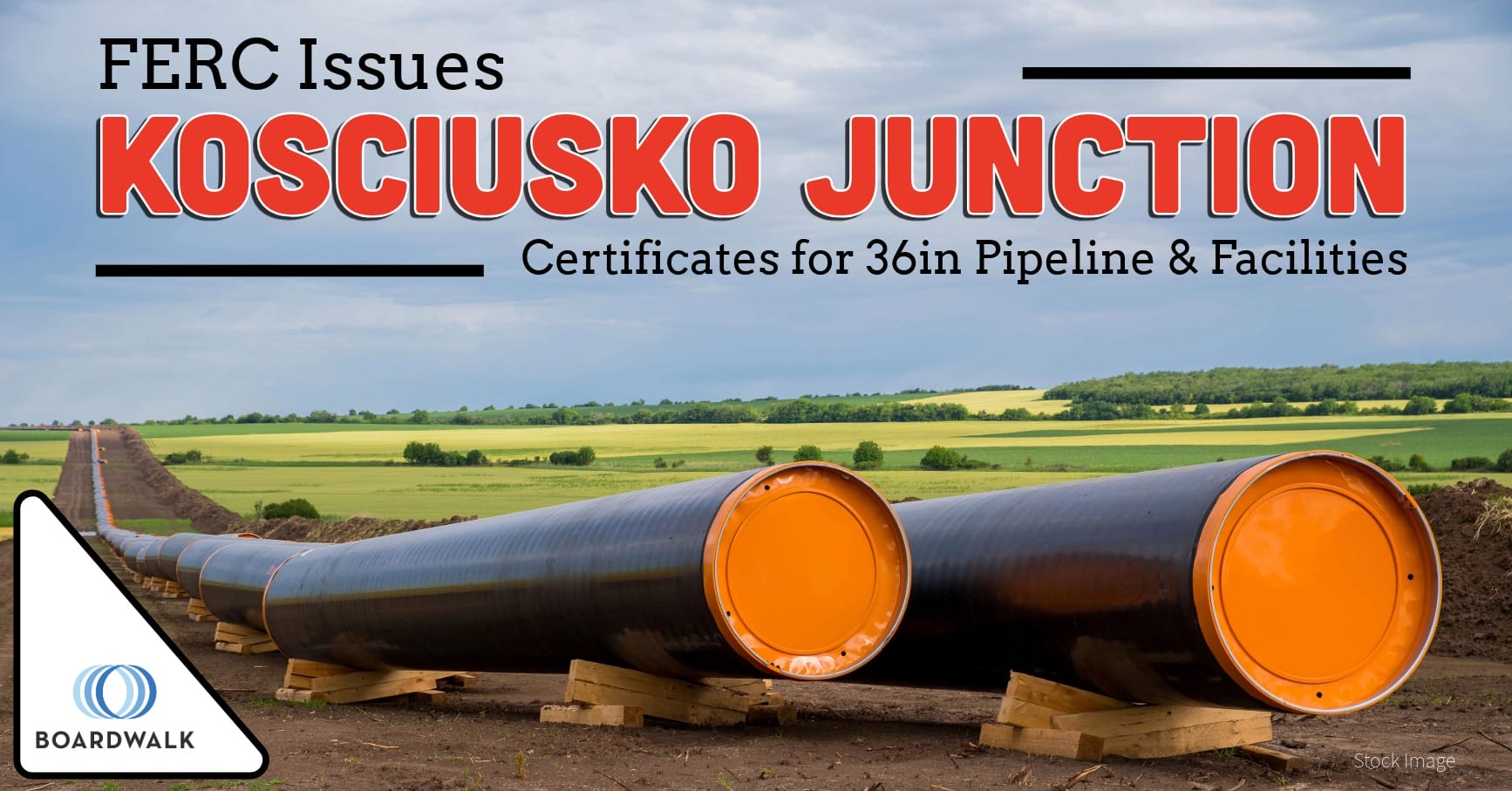
FERC’s September order authorizes new 36-inch pipeline, compressor-station and related facilities in Mississippi, moving Boardwalk’s Kosci Junction project from development and environmental review into its certificate-compliance phase.
Published by Efrain Garcia, Editor in Chief of Allstream Insiders
Allstream Insiders Summary
The Federal Energy Regulatory Commission has issued certificates and approved abandonment actions for the Kosciusko Junction Pipeline Project, authorizing Gulf South Pipeline Company, LLC and Texas Gas Transmission, LLC to construct and operate the Mississippi natural-gas infrastructure project.
According to FERC’s September 10 order, the project is designed to create approximately 1.175 million dekatherms per day of incremental firm transportation capacity. Gulf South and Texas Gas are subsidiaries of Boardwalk Pipeline, LP.
The authorization follows Boardwalk’s 2024 final investment decision and FERC’s 2026 environmental review. The certificate is a major regulatory milestone, but it does not establish that field construction has started or that project-specific contractor and supplier awards have been issued.
The third major milestone in the project’s development
| Project milestone | Status |
|---|---|
| Boardwalk final investment decision | Announced December 2024 |
| FERC environmental review | Draft EIS issued April 2026; final EIS issued July 2026 |
| FERC certificate order | Issued September 10, 2026 |
Allstream Insiders previously covered Boardwalk’s final investment decision and FERC staff’s draft environmental impact statement.
Those earlier announcements concerned a company investment decision and FERC’s environmental-review process. The certificate order is the subsequent federal authorization that allows the companies to advance the proposed facilities, subject to the conditions in FERC’s order.
What FERC authorized
FERC describes Kosci Junction as a pipeline and compressor-station construction project in Mississippi. The certified scope includes:
- Approximately 102 miles of new 36-inch pipeline from Attala County to Clarke County;
- approximately 8 miles of new 36-inch pipeline in Humphreys and Sunflower counties;
- a new Kosci Compressor Station in Attala County;
- a new Holmes Compressor Station in Holmes County;
- modifications to the existing Greenville Compressor Station in Washington County;
- modifications to the existing Isola Compressor Station in Humphreys County;
- acquisition and abandonment actions involving existing facilities; and
- related transportation capacity, meter, regulating and appurtenant facilities.
FERC’s certificate action applies to Gulf South and Texas Gas under Docket Nos. CP25-547-000 and CP25-549-000. The order also authorizes the applicants to acquire transportation capacity through two lease agreements and to acquire and abandon existing facilities as part of the broader project configuration.
What the project is intended to do
Boardwalk has described the project as an expansion of its natural-gas transportation system across Mississippi and the Southeast. The company says the development is intended to connect supplies from the Midcontinent, Marcellus and Fayetteville regions to growing power-generation, data-center, industrial and utility demand.
Boardwalk’s project materials describe approximately 111 miles of new 36-inch pipeline, new compressor stations in Attala and Holmes counties, and modifications at existing stations in Washington and Humphreys counties. The company has identified a project design capacity of up to 1.16 Bcf/d, with potential expansion to 1.58 Bcf/d.
Those company planning figures provide commercial context. FERC’s order establishes the federal authorization for the currently certificated facilities and capacity, rather than approval of every potential future expansion.
Certificate approval is not the same as a construction start
FERC says Gulf South and Texas Gas must satisfy the environmental conditions in the order before construction begins. Commission staff will monitor construction for compliance with those requirements.
Boardwalk’s current project timeline lists construction during 2027–2028, partial in-service as early as April 2028, and full in-service in September 2028. Those dates are company planning targets, not confirmation that construction is underway or that all conditions, land rights, procurement packages and field-mobilization requirements have been completed.
Boardwalk also states that it has not identified project-specific job openings or contracting opportunities at this time.
What the certificated scope could mean for suppliers and contractors
Allstream perspective: If Boardwalk progresses from certificate compliance into field execution, the disclosed project configuration could require substantial pipeline and compressor-station work.
Potential requirements for a project of this type may include line pipe, fittings, valves, meter and regulating equipment, compressor packages, turbine or electric-drive equipment, controls and SCADA, electrical systems, civil construction, foundations, access roads, welding, nondestructive examination, coating, hydrostatic testing, inspection, restoration and commissioning.
New and modified compressor stations could also require station piping, structural steel, instrumentation, safety and emergency-shutdown systems, emissions controls, insulation, painting, scaffolding, equipment rentals and long-term maintenance support.
These are examples of work commonly associated with a certified pipeline-and-compression project. They are not announced awards, procurement packages or confirmed contractor commitments for Kosci Junction.
What to watch next
The next decision-useful signals will be FERC compliance filings, authorization to commence construction, Boardwalk construction notices, right-of-way activity, procurement packages, equipment orders, contractor awards and field-mobilization updates.
For now, Kosci Junction should be tracked as a FERC-certificated, pre-construction infrastructure project with a defined pipeline and compression scope—not as a project already under construction.