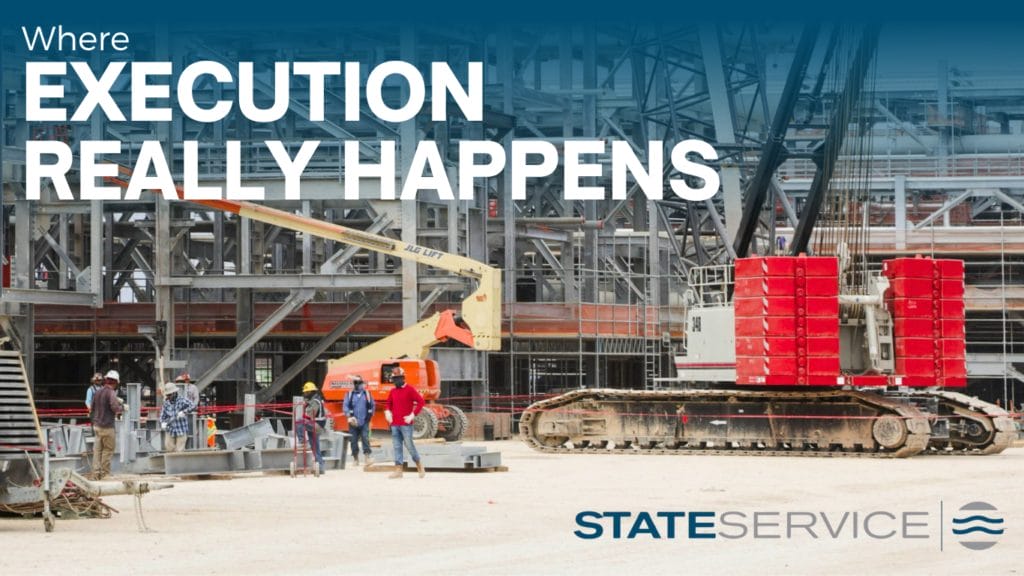
State Service, leaders in modular fabrication with a module yard in Ingleside, TX
When a multi-million-dollar modular process facility or industrial project runs over budget or misses its commissioning deadline, the root cause is rarely a flawed engineering drawing.
Most major EPCI failures occur in the physical transition from design to reality — because the chosen fabrication partner lacked the infrastructure to execute the plan efficiently.
Today, procurement teams often evaluate contractors based on software capabilities, ISO certifications, and management resumes. These “paper qualifications” are necessary but not sufficient. Paper doesn’t build modules; yards do.
To achieve true project certainty, owners must evaluate the physical constraints of the fabrication yard itself. Here’s why a contractor’s physical assets are the ultimate determinant of your project’s success.
The Illusion of the “Paper Contractor”
If two fabrication companies both claim 40 years of experience, a safety-first culture, and 3D CAD capabilities, they look identical on a spreadsheet.
But if Company A operates a 15-acre landlocked yard and Company B operates a 70-acre waterfront facility with 500-ton cranes, their execution strategies are radically different. Company A fragments your project, navigates highway logistics, and pushes critical assembly hours into the field. Company B builds the module whole, tests it in the yard, and ships it directly to site.
The spreadsheet doesn’t show that risk. The infrastructure does.
The Four Pillars of Project-Defining Infrastructure
Evaluating an EPCI partner means going beyond the boardroom and auditing the yard. These are the four physical pillars that actively de-risk capital projects.
1. Waterfront Access vs. The Highway Bottleneck
If your fabricator doesn’t have direct, load-bearing water access, your project schedule is at the mercy of the Department of Transportation.
Landlocked yards are constrained by bridge heights, weight restrictions, and complex permitting, forcing engineers to design smaller modules that fit on a truck. State Service Co. (SSCI) in Ingleside, TX operates with 2,000 linear feet of load-bearing bulkhead directly on the Gulf Intracoastal Waterway, enabling the fabrication of large, fully integrated modules loaded via SPMTs directly onto barges. That eliminates the highway bottleneck and shaves weeks off delivery schedules for industrial, petrochemical, and energy projects alike.
2. Heavy-Lift Capacity and Vertical Integration
A yard is only as capable as what it can lift.
Limited crane capacity means more lifts with smaller pieces. Every additional lift introduces safety risk, more structural welding, and additional QA/QC time. High-capacity lifting, with cranes rated at 500+ tons, allows a yard to build upward and outward. Modules are assembled in larger blocks, minimizing total connections, accelerating timelines, and producing a structurally superior final product.
3. Acreage and Workflow Optimization
Space is time.
Cramped yards force trades to work on top of one another, increasing accident risk and rework. Lack of space also forces sequential building, where one task must finish before the next begins. SSCI’s 70-acre facility with 25,000 sq. ft. of covered production creates room for parallel workflows: structural framing in one area while internal piping is prefabricated in another. Parallel execution is the single greatest lever for compressing a fabrication schedule.
4. Integrated Testing and Commissioning
A module fabrication yard shouldn’t function as an assembly point that subcontracts critical testing.
Every time a module leaves the yard for specialized inspection or an outside vendor is brought in, you introduce logistical friction, schedule delays, and split liability. SSCI’s dedicated integrity services division operates within the same footprint as the fabrication teams. Precision torquing, hydrostatic testing, nitrogen testing, and pipeline verification are executed as part of the fabrication workflow. The craftsmen who built the system are present during testing, enabling immediate troubleshooting and ensuring the asset is certified before it ever leaves the yard.
Why Yard Infrastructure Dictates Field Costs
The goal of modular fabrication is to shift man-hours away from the field, where labor costs are significantly higher, timelines are weather-dependent, and logistical complexity compounds quickly.
When a fabricator has the waterfront access, heavy-lift capacity, and integrated testing infrastructure to deliver a fully commissioned, plug-and-play module, field installation becomes a connection exercise rather than a construction project. Whether the destination is an industrial complex, a petrochemical facility, or an offshore platform, the return on superior yard infrastructure is realized the moment the module arrives on site.
Don’t Audit the Proposal. Audit the Yard.
In the energy and industrial sectors, proposals don’t reveal execution capacity. The true measure of your EPCI partner is written in concrete, steel, and deepwater bulkheads.
We invite project owners, engineering directors, and procurement teams to verify our capabilities in person. Come walk the 70 acres at State Service Co. Evaluate our cranes, inspect our testing facilities, and stand on our bulkhead.
See exactly how the right infrastructure builds project certainty.
Ready for a Real Risk Assessment? Stop comparing credentials and start comparing execution capacity. Contact State Service Co. to schedule a comprehensive module yard tour at our Ingleside, Texas, facility.
Since 1976, State Service has provided innovative EPC/EPCI solutions to companies in every energy sector. Our growth over the last four decades demonstrates our unsurpassed commitment to project excellence and innovation, along with a steadfast focus on quality, safety, reliability and timeliness.
We pride ourselves on our veteran team. Combine our experienced team with our strategically located fabrication facility along the Gulf Intracoastal Waterway in Ingleside, Texas, and we are positioned to see your project from inception through completion.