This article is brought to you by: Turner Industries, leaders in modular fabrication, SIPA, and turnkey nuclear solutions for smr companies

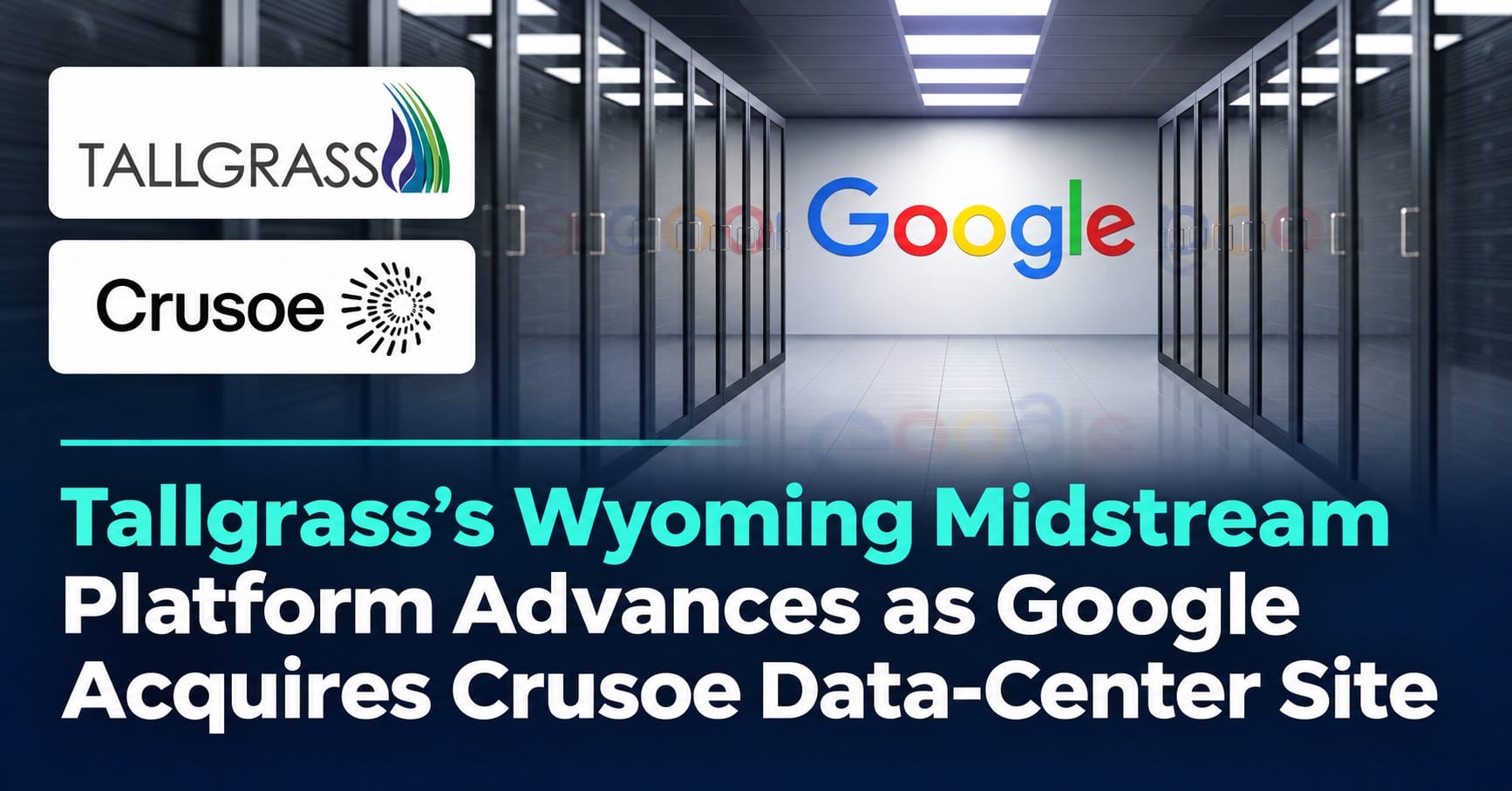
Google’s acquisition of Crusoe’s southeast Wyoming site follows the campus’s original development with Tallgrass Energy, placing the midstream company at the intersection of natural-gas power, carbon storage and hyperscale data-center infrastructure.
Published by Allstream Insiders
Allstream Insiders Summary
Google has acquired the southeast Wyoming data-center site previously developed by Crusoe, completing Crusoe’s pre-development work on the project, according to Crusoe’s November 6 announcement. Crusoe said that work included site selection, governmental approvals and a hybrid power strategy developed with Tallgrass Energy.
The transaction places Google at the center of a campus concept first announced by Crusoe and Tallgrass in July 2025. At that time, the companies described an initial 1.8-gigawatt AI data-center campus in southeast Wyoming designed to scale to as much as 10 GW, using a power strategy that included natural gas, future renewable-energy development and access to Tallgrass’s natural-gas, water and carbon-dioxide infrastructure.
Google separately announced November 5 that it plans a long-term $17 billion investment in Wyoming for its first data center in the state. Google identified Tallgrass as a project partner and said it plans to source power from gas generators operated by Tallgrass and Black Hills Energy. The company also identified Tallgrass’s Eastern Wyoming Sequestration Hub as the planned destination for captured carbon dioxide associated with a proposed 702-megawatt fuel-cell development.
The acquisition does not establish a new final investment decision, EPC award or construction schedule for every element of the campus. It does, however, provide a clearer example of how a midstream company’s existing gas, water and carbon-management infrastructure can become part of the platform supporting large data-center development.
From Tallgrass–Crusoe development to Google-owned site
Tallgrass and Crusoe originally announced their Wyoming partnership in July 2025. The companies described a 1.8-GW AI data-center campus in southeast Wyoming, with a stated potential to scale to 10 GW. Their announced strategy combined multiple power sources fueled by natural gas and future renewable-energy development.
Crusoe said Google’s acquisition completes its role in the project’s pre-development work. According to Crusoe, the companies had coordinated data-center engineering, energy-system design, site development and hyperscaler engagement while developing the campus.
The company also said the hybrid strategy developed with Tallgrass combined fuel cells, grid power and natural-gas turbines, with a longer-term carbon-capture pathway using Tallgrass’s regional carbon-dioxide sequestration hub.
The disclosed transition is a change in site ownership and development leadership, not an indication that Tallgrass has exited the project. Google’s subsequent announcement continues to identify Tallgrass as a partner in the Wyoming development and describes specific Tallgrass-related power and carbon-storage roles.
Tallgrass links gas power, carbon storage and data-center demand
Google’s announced Wyoming configuration positions Tallgrass across multiple infrastructure functions. Google said the project will source power from gas generators operated by Tallgrass and Black Hills Energy. It also said captured carbon dioxide from the proposed fuel-cell development would be permanently stored at Tallgrass’s nearby Eastern Wyoming Sequestration Hub.
Google said it is contracted with American Electric Power, or AEP, for a planned 702-MW fuel-cell development with carbon capture and storage. Bloom Energy is expected to manufacture the fuel cells. Google also said it is undertaking a technical front-end engineering and design, or FEED, study to evaluate fitting Tallgrass combined-cycle turbines with carbon-capture technology.
Those disclosures describe distinct scopes. The 702-MW fuel-cell development is a named planned component of the project, while the Tallgrass turbine work remains an engineering evaluation. Google did not disclose a final investment decision, equipment supplier, capital budget, construction contractor or in-service date for a possible turbine retrofit.
A midstream company’s infrastructure becomes part of the data-center solution
The Wyoming development illustrates how the midstream role can extend beyond conventional transport and storage arrangements. Large data centers require reliable, large-scale energy supply, and increasingly are seeking lower-emissions power configurations and long-term carbon-management pathways.
Tallgrass’s existing and proposed Wyoming infrastructure gives it relevance across the project’s energy chain: natural-gas-related power supply, water and site infrastructure, and permanent geologic carbon-dioxide storage. That combination creates a different value proposition than a stand-alone pipeline, generation or data-center project.
For the broader midstream sector, the development signals that companies with integrated gas, CO2, water and power-adjacent assets may have opportunities to support the buildout of AI and data-center infrastructure. Whether individual assets move into execution will depend on permits, commercial agreements, engineering results, equipment selections and final investment decisions.
What has not been disclosed
Neither the Google nor Crusoe announcements disclose the value of Google’s acquisition of the Crusoe site. They also do not identify a campus-wide construction schedule, final capacity buildout, EPC contractor, natural-gas supply agreements, carbon-dioxide pipeline route, injection-well count, equipment packages or a detailed allocation of Google’s stated $17 billion Wyoming investment.
The $17 billion figure should not be treated as a construction budget for Tallgrass assets, the 702-MW fuel-cell development, carbon-capture equipment, the sequestration hub or a potential combined-cycle turbine retrofit.
What could be involved if the project advances into execution?
Allstream perspective: Subject to final engineering, permits and commercial agreements, a project that combines data-center development, natural-gas generation, fuel cells and carbon capture could involve gas-supply infrastructure, metering and compression, electrical interconnection, substations, fuel-cell balance-of-plant systems, CO2 dehydration and compression, pipelines, injection wells, monitoring systems, civil work, fabrication, insulation, coatings, controls, testing and commissioning.
These are potential categories of work—not announced Tallgrass, Google, AEP, Bloom Energy or Crusoe awards. The companies have not identified individual engineering, procurement, construction, pipeline, drilling, electrical or equipment suppliers for the scopes discussed in their announcements.
Allstream perspective: Tallgrass offers the midstream bridge to new energy demand
Google’s acquisition of the Crusoe-developed site gives Tallgrass’s original Wyoming data-center platform a new customer and development context, while preserving the strategic relevance of Tallgrass’s energy infrastructure. The company is positioned in the disclosed plan as a power-infrastructure operator and as the named destination for permanent carbon-dioxide storage.
The decision-useful next milestones will be final investment decisions, engineering outcomes, permits, generation and storage specifications, injection volumes, commercial agreements, equipment orders and construction awards. Until then, the Wyoming development should be viewed as a major announced data-center and energy-infrastructure platform—not as a fully sanctioned or fully awarded construction program.