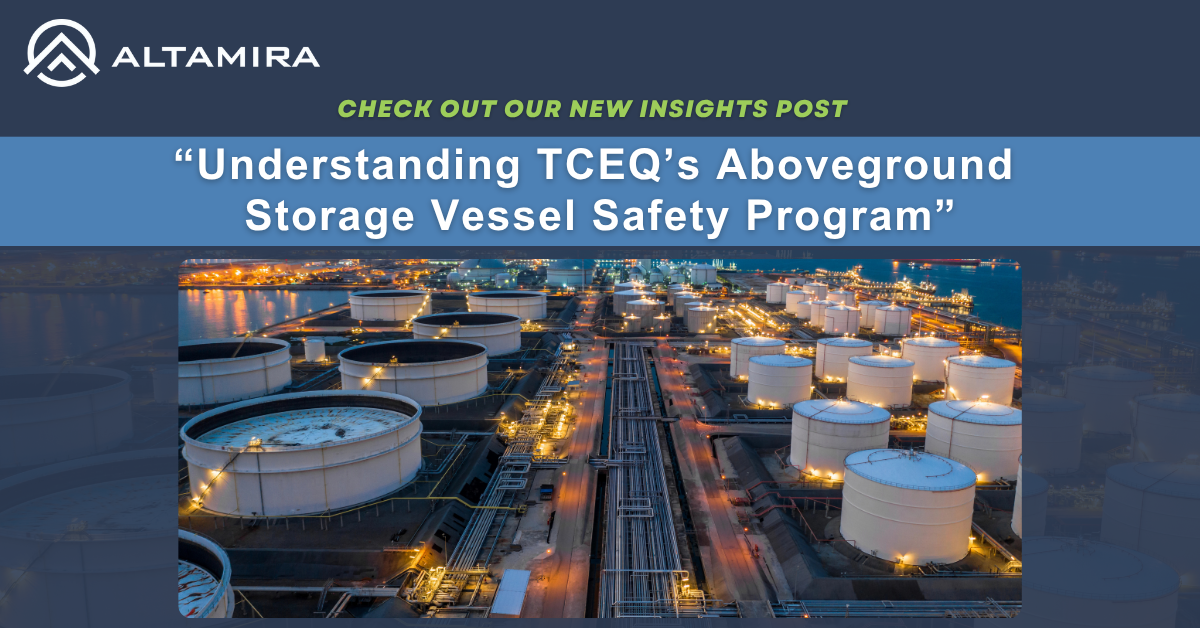
What Texas facilities need to know about applicability, registration and early compliance preparation
Author: Andreana Ibarra | September 2, 2026
What Is the TCEQ Aboveground Storage Vessel Safety (ASVS) Program?
The Texas Commission on Environmental Quality (TCEQ) established the Aboveground Storage Vessel Safety – ASVS Program under 30 Texas Administrative Code (TAC) Chapter 338. The program implements Senate Bill 900 (87th Texas Legislature), which amended the Texas Water Code and directed TCEQ to establish safety requirements for certain aboveground storage vessels. Chapter 338 introduces registration, safety-standard, documentation and certification requirements for certain large aboveground storage vessels at petroleum refineries, petrochemical plants and bulk storage terminals.
Its purpose is to help protect groundwater and surface water in the event of an accident or natural disaster. ASVS requirements apply in addition to — not in place of — other applicable federal and state air, water, waste, environmental and safety obligations.
Who should read this? Environmental, EHS, operations, terminal, asset-integrity, engineering and tank-inspection personnel at Texas petroleum refineries, petrochemical plants and bulk storage terminals should evaluate whether their facilities and vessels are subject to Chapter 338.
Which Facilities and Vessels Are Subject to TCEQ ASVS Program?
A vessel may fall within the ASVS Program when all the following conditions are met:
- It is located at a petrochemical plant, petroleum refinery or bulk storage terminal.
- It has a nominal design capacity of 21,000 gallons (500 barrels) or more, based on the maximum working fill capacity or overfill level.
- It stores a regulated substance as defined by 30 TAC Chapter 338.
- It is constructed of non-earthen materials.
This makes the program especially important for large stationary storage vessels at qualifying Texas refining, petrochemical and bulk-terminal sites. Facilities outside these defined site categories do not require ASVS registration.
What Are the Regulations for Aboveground Storage Tanks in Texas?
A large vessel is not automatically an ASVS-regulated storage vessel. TCEQ identifies several exclusions, including many vessels used for crude oil or natural-gas production or gathering, stormwater or wastewater systems, flow-through process operations, vessels operated above 0.5 psig, heated tanks, mobile intermediate bulk containers, liquefied-petroleum storage and certain tanks regulated by the U.S. Department of Transportation’s Pipeline and Hazardous Materials Safety Administration (PHMSA).
Because the applicability determination depends on both the facility and the vessel, operators should carefully evaluate their inventories rather than relying on size alone.
Important Program Dates:
- Program Effective – August 24, 2023
- Registration Deadline for Facilities – September 1, 2027
- Existing-Vessel Self-Certification – September 1, 2037
What Tank Compliance Involves
Compliance begins with identifying regulated vessels and evaluating applicable safety standards. Depending on vessel-specific applicability, TCEQ’s registration and certification framework addresses established programs and standards that may include:
- 40 CFR Part 112 — Spill Prevention, Control, and Countermeasure (SPCC)
- 40 CFR Part 68 — Risk Management Program (RMP)
- API Recommended Practice 2001; API Standards 2350, 650 and 653
- NFPA 30, Sections 22.4 and 22.8
For a standard that applies but is not yet met, the registration requires a planned compliance date. If compliance is technically infeasible, a facility may request a waiver with supporting documentation.
Preparing for ASVS Registration with STEERS
What is STEERS? STEERS is the State of Texas Environmental Electronic Reporting System. This is where facilities subject to 30 TAC Chapter 338 must register by September 1, 2027. TCEQ requires the owner, operator or an authorized representative to submit the registration and encourages regulated facilities to register early once the registration system is available. Failure to register by the deadline may result in violations.
Before registration, facilities should compile a complete and supportable record of the following information:
- Facility identifiers, location details, primary NAICS code and regulated-entity information.
- Owner, operator, billing, primary-contact and safety-manager details.
- For each regulated vessel: identification number, construction and operation dates, design capacity and construction material.
- The applicability and compliance status for each relevant safety standard.
- Certification support or waiver documentation, when applicable and the location of stored records.
TCEQ offers a required-information worksheet and a vessel-import spreadsheet template to help facilities organize data for STEERS submission. Facilities should verify the latest STEERS availability and registration instructions directly with TCEQ as the deadline approaches.
Registration fees apply on a per-vessel basis and vary by vessel capacity. Under TCEQ’s current fee schedule, vessels from 500 to 20,000 barrels are assessed $200; vessels from 20,001 to 749,999 barrels are assessed $200 plus $0.0024 per barrel; and vessels of 750,000 barrels or greater are assessed $2,000. Facilities that register before September 1, 2027, will be invoiced after November 1, 2027, rather than paying the fee upon submission.
How Altamira Can Support your ASVS Preparation
Preparing for ASVS can involve environmental, operations, engineering, integrity, inspection and compliance teams. Altamira’s ASVS Readiness Assessment provides a practical, organized approach to identifying potentially regulated vessels, documenting exclusions, evaluating applicable standards, identifying compliance gaps and preparing for registration.
Services may include:
- ASVS applicability evaluations and tank-inventory reviews
- Identification of regulated and excluded vessels
- Development of the required vessel registration inventory
- Review of existing inspection and compliance documentation
- Evaluation of applicable API, NFPA, SPCC and RMP requirements
- Identification of potential compliance gaps
- Preparation and support for TCEQ STEERS registration
Altamira brings environmental, engineering, asset-integrity and regulatory-compliance capabilities to help organizations organize their information, assess requirements and develop a practical path toward ASVS compliance.
Start Early To Protect Time and Resources
The September 1, 2027, deadline is more than a data-entry exercise. Facilities may need time to validate vessel inventories, document exclusions, determine which safety standards apply, locate inspection and design records and resolve documentation or compliance gaps. Beginning early gives facilities time to address these issues and coordinate the appropriate environmental, operations, engineering, integrity and inspection teams.
Leveraging an experienced advisor such as Altamira can help avoid wasted time and resources while supporting a complete, defensible approach to meeting ASVS requirements.
A Practical Next Step: ASVS Readiness With Altamira
A focused readiness review can turn the ASVS requirements into a manageable work plan.
Facilities can begin by:
- Confirming whether each facility meets the refinery, petrochemical plant or bulk storage terminal definition.
- Creating a complete inventory of vessels at or above the 21,000-gallon threshold.
- Separating potentially regulated vessels from excluded equipment and documenting the basis for each decision.
- Collecting inspection, design, spill-prevention and safety-program records before registration begins.
Meet the Author

Andreana Ibarra
Senior Environmental Consultant
Mrs. Ibarra is a Senior Program Manager at Altamira with more than 23 years of experience in environmental compliance, permitting and regulatory strategy. Her expertise spans SPCC planning, aboveground storage, stormwater compliance, environmental auditing and regulatory permitting for oil and gas, petrochemical, energy and industrial facilities.
She works closely with facility owners and operators to navigate complex regulatory requirements and develop practical, effective compliance strategies. With extensive experience developing and managing SPCC and environmental compliance programs, she is currently helping Texas facilities understand, prepare for and comply with the TCEQ Aboveground Storage Vessel Safety (ASVS) requirements.
Click Below to Get Connected with Altamira